- calendar_today August 14, 2025
.
Electric vehicle adoption in the US is coming under renewed doubt after a period of steady monthly sales growth that lasted for more than a year. With EV sales now beginning to contract, some brands such as Genesis and Volvo are already seeing consumers walking away from their electric models, leading to plans to scale them back.
The issue has also been exacerbated by political uncertainty, with the current administration moving to cut subsidies and loosen vehicle pollution standards, leaving far fewer federal incentives for buyers. But as Telemetry research shows, the biggest impediment to EVs may not be policy—it may already be sitting in Americans’ garages.
If surveys are to be believed, range and charging anxiety are already among the biggest reasons holding potential EV adopters back. A new market research report from Telemetry Vice President Sam Abuelsamid digs deeper into the issue, pointing to a factor that is regularly overlooked.
At the risk of oversimplifying matters, headlines these days are dominated by fast-charging networks along highways and in dense urban corridors. But the vast majority of all EV charging, according to estimates, continues to take place at home, with AC power. One NREL study showed that 42 percent of homeowners park near an outlet capable of delivering level 2 (240 volt) charging.
That share could increase dramatically, to 68 percent, if home charging advocates have their way. That would require homeowners to not only clear out their garages, but to change their parking behavior in the process. As Abuelsamid explains, “90 percent of all houses can add a 240 V outlet near where cars could be parked. Parking behavior, namely whether homeowners use a private garage for parking or storage, will likely become a key factor in EV adoption.”
There is still the issue of just how many of those outlets are in use or even available. In the US, there are more than 130 million homes, and just 31 million are able to accommodate an EV charger in their garages. That number could more than double, to 50 million, if homeowners reorganized their garages and rethought where they parked their cars. Factoring in single-family residences where new wiring can be accommodated, the share of homes that could be used to charge an EV rises to more than 72 million.
The problem is that capacity on paper does not equal readiness on the ground. The same NREL study calculated that nearly 34 million homes would require a major electrical upgrade in order to support a 240-volt level 2 charger. That level of power typically demands at least 30 amps. Electrical work, depending on the home in question, can range from new wiring to entire electrical panel replacements. For homeowners, the work can mean thousands of dollars in upgrades.
All that does not square with what has been one of the main selling points of EVs to date: that they are far cheaper over the long term than traditional gas-powered cars. Add the cost of installing the infrastructure for charging to the purchase price of the vehicle itself, and the overall cost of ownership can quickly start to rival, if not exceed, that of a gas-powered vehicle.
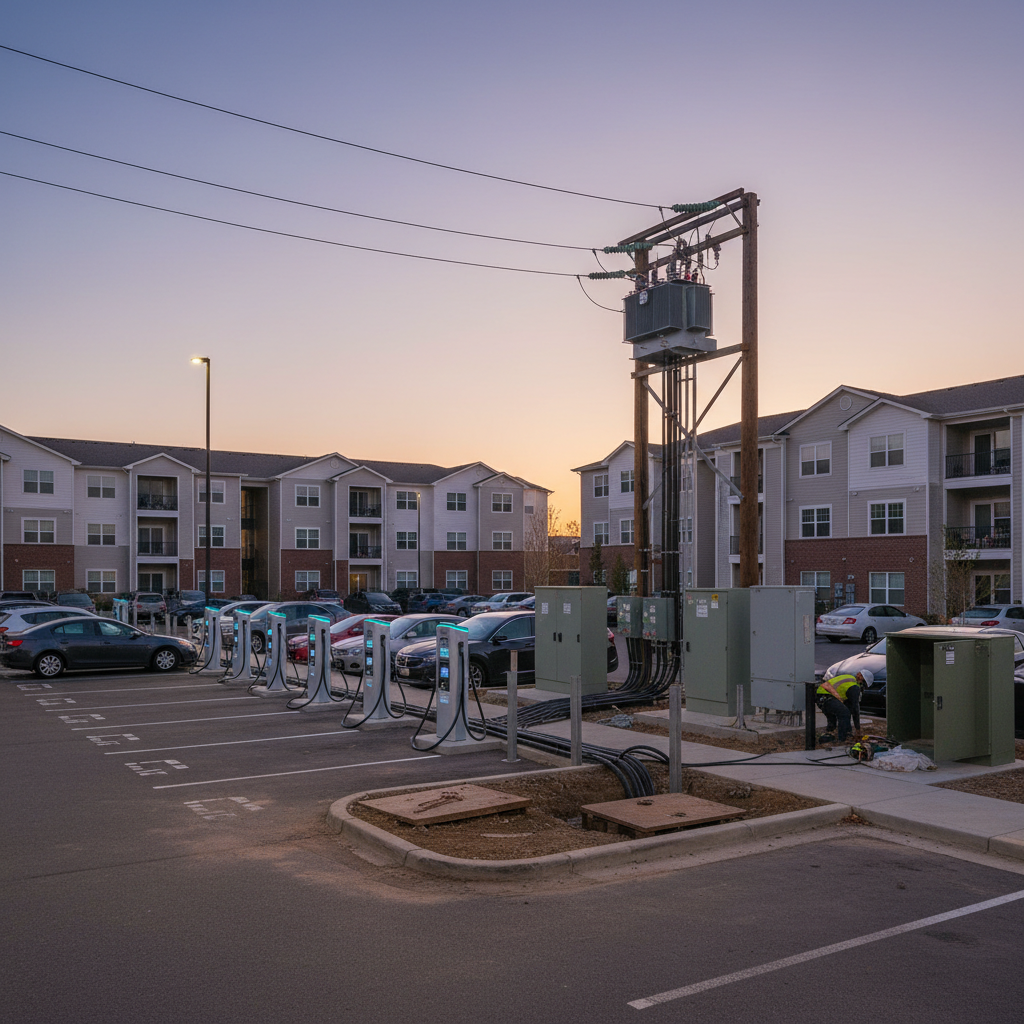
All this also makes for an even steeper challenge for the 23 percent of Americans who live in so-called multifamily dwellings. Apartments, condos, and townhomes all fall under this umbrella. But unlike in single-family homes, individual EV owners living in these structures typically do not have the freedom to install chargers where they want.
Instead, they must persuade landlords, property management companies, or co-op boards to allow the installation. This approval can often be hard to come by, despite the efforts of state and local governments, utilities, and local incentive programs to offer assistance and funding to try to lower the barriers.
The financial burden is also larger for multifamily buildings. Installing a pair of shared level 2 chargers at a condo, for instance, may first require a complete electrical panel upgrade. In a co-op, such work can cost millions of dollars. Wiring runs to remote parking spaces and common areas also add to the bill. Renters and owners in these buildings are typically not eligible for municipal or utility subsidies for charger installation, either.
The current number of EVs parked in multifamily dwellings is around one million, but the share of EV owners that park close enough to an outlet to charge is just 11 percent. There are efforts under way in some states to require 20–25 percent of all parking spaces in new developments to be EV-ready, but even if this provision were universal across the country, Telemetry estimates that only 6.7 million to 11.4 million charging-capable parking spaces will exist in multifamily dwellings by 2035. That figure is still far short of demand.
Home charging has its limits, however, and a critical mass of public charging infrastructure will be necessary to meet that demand. Telemetry projects that between 11.7 million and 14.3 million EV drivers that own single-family homes will use public charging in 2035. Another 7.8 million to 8.1 million EV owners that live in multifamily residences will also count on public charging stations.
Meeting that demand will require between 523,000 and 586,000 DC fast chargers, as well as 1.5 million to 1.6 million level 2 chargers nationwide. This is a far cry from the level of investment necessary to make charging at home more accessible to all, but it also presents some challenges of its own.
The growth of fast-charging networks, particularly ones with dozens or even hundreds of chargers in key locations, will also tax the already-strained capacity of power companies. New AI data centers are already competing with these sites for generation and distribution capacity, which will make the rollout of large charging sites even more difficult.
While headlines continue to point to record growth and exuberant optimism over the prospects of EVs and the charging sector, the outlook for the US market is more complicated than it may seem. Millions of homes are theoretically capable of installing EV chargers and powering them with little to no added infrastructure. But cluttered garages, the costs of upgrading electrical systems, and the complex economics of multifamily housing have all slowed adoption.
Even if public charging expands as planned, total capacity is likely to fall short of the level of demand expected in the coming decade. As more eyes shift to the question of how to ensure universal access to EVs, the issue of parking and charger readiness in the nation’s garages has the potential to upend even the most optimistic projections.