- calendar_today August 15, 2025
From Cyanide to Sewer Tentacle: How Sil Got Her Revenge
Earlier this month, the Hollywood community said goodbye to actor Michael Madsen, best known to filmgoers for his tough-guy performances in films like Reservoir Dogs, Kill Bill, and Donnie Brasco. Madsen had a long career with plenty of fan-favorite supporting turns, but one role has often gone unremembered in obituaries: his part in the 1995 sci-fi thriller Species as a black ops mercenary hunting a dangerous half-human, half-alien hybrid. This year, the film is turning 30, and it’s worth a look, both for nostalgia’s sake and as an example of the kinds of risks filmmakers were willing to take in the ’90s, when Hollywood was flush with big-budget monster movies and alien-invasion paranoia.
Species, directed by Roger Donaldson (No Way Out, The Bounty), was an odd mix of gothic horror, action-thriller, and soft science fiction. The movie opens with the U.S. government receiving two signals from outer space, one containing data on a new fuel source, the other a detailed set of instructions on how to splice alien DNA with human DNA. Naturally, the U.S. government acts on this information. Under the leadership of Dr. Xavier Fitch (Ben Kingsley), a hybrid human/alien organism is created, codenamed Sil and played in her early years by Michelle Williams. The government expects to have a docile, controllable organism on its hands. What it gets, however, is something very different.
Sil develops at an accelerated rate, gaining the appearance of a 12-year-old girl within the space of three months. But not all is well. She experiences violent nightmares, and it becomes clear that Sil might not be as controllable as Fitch and his team had hoped. When Fitch orders the experiment to be terminated by pumping cyanide into Sil’s containment cell, the organism manages to escape.
Calling in Madsen as Preston Lennox (along with Dr. Laura Baker, Marg Helgenberger, anthropologist Dr. Stephen Arden, Alfred Molina, and Dan Smithson, Forest Whitaker) to track Sil down, Fitch and his team follow her trail from San Francisco to the East Coast and, finally, to Los Angeles, where she has grown into adulthood and is played by Natasha Henstridge. There, Sil sets about finding a mate to reproduce. She is intelligent, adaptable, and, more importantly, completely driven by instinct. A fatal combination, as a train tramp, a nightclub acquaintance, and an eventual lover will discover the hard way.
Species Was a Movie About a Monster Designed to Seduce—and Kill
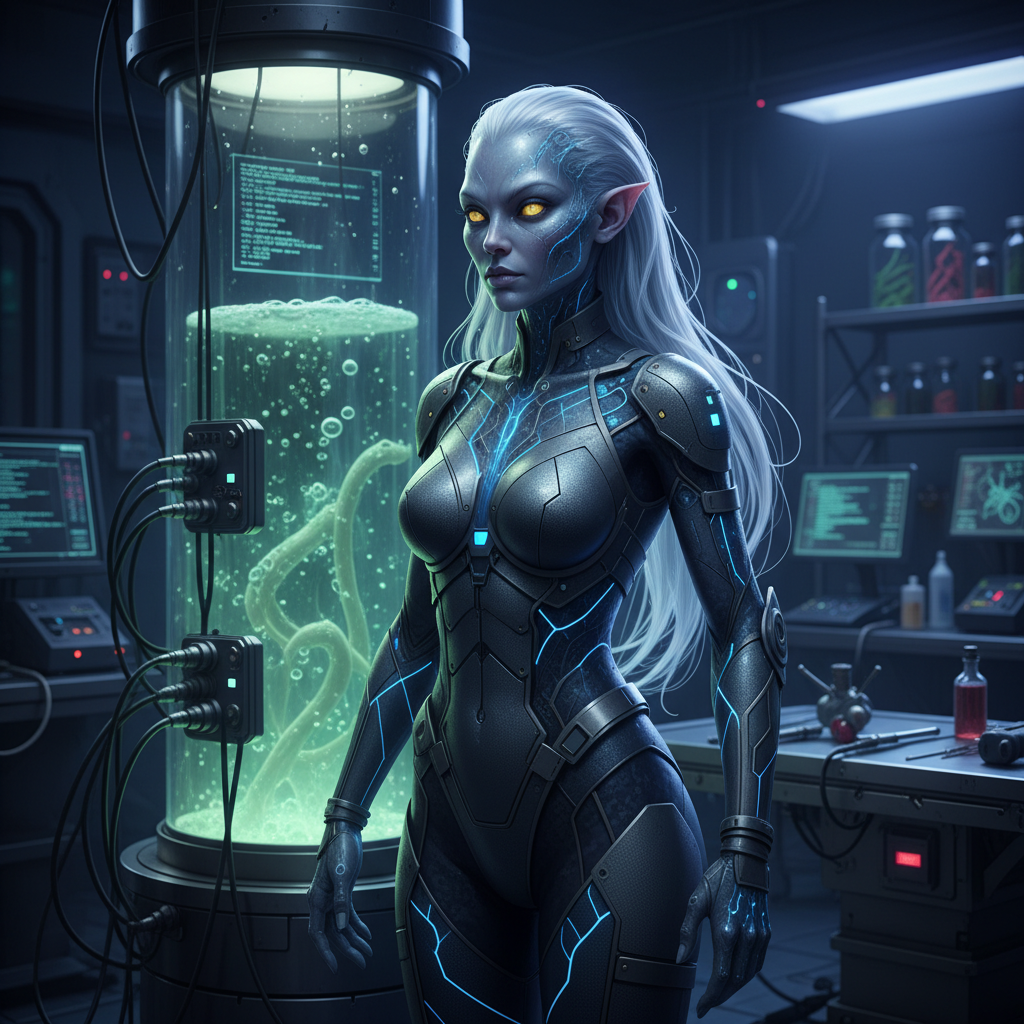
One of the most visually striking things about Species was the design of the alien-human hybrid itself. Filmmakers enlisted legendary surrealist artist H.R. Giger, who had previously designed the xenomorph for Ridley Scott’s Alien, to design Sil. “We wanted to create a being that could function both as an aesthetic warrior, also sensual and deadly,” Giger wrote in his notes on Sil. “Its last form in the film is very transparent, which looks like a glass body, but the whole interior is constructed of carbon.”
Giger’s design for the alien-human hybrid was impressive, its final form having translucent skin (referred to in production notes as “glass body but with carbon inside”). Giger had wanted multiple stages of Sil’s alien evolution to be shown, and built the puppets for the movie accordingly. But the film had budget constraints, so Giger was limited to one transformation cocoon and the climactic maternal alien body.
Giger was far from pleased with the film when it was released, despite the creature’s commercial success. He felt that Species had ripped off a lot of his earlier Alien work: the “punching tongue,” he thought, “looked exactly like the xenomorph,” and the iconic birth scene in the climax was too much of a retread of Alien’s chestburster moment. Giger even got involved during production to stop Sil being vaporized by flame throwers, which he said resembled too many other moments in both Alien 3 and Terminator 2.
Species wasn’t a universally loved movie, despite its success and intriguing visuals. The dialogue was often poor, and many of the characters were thinly written and one-note. Kingsley’s Fitch, in particular, is a more-than-a-bit unconvincing as the film’s amoral mad scientist. Whitaker is a brooding presence but otherwise mostly has to state the obvious. And a lot of the more intriguing ideas are left on the table. Sil’s bioethics, alien contact, and maternal instincts are all touched on, but never developed. The special effects were solid, if unremarkable. And yet, the film has an odd magnetism to it, if only for its bizarre mishmash of sexed-up science fiction and gothic horror. Feldman, the screenwriter, had been reading an article by Arthur C. Clarke on how aliens would never likely visit Earth because of the sheer impossibility of faster-than-light travel, and began to wonder about alternate means of extraterrestrial contact. What if, he thought, alien intelligence sent a signal to Earth containing a blueprint for an organic, self-replicating machine?
Species combined the thriller, the cautionary tale, and the creature feature. It will probably never be mentioned in the same breath as Alien or The Terminator, but it did carve out a dedicated cult fan base for itself. And for good reason. Between Henstridge’s performance, Madsen’s sleazy, world-weary charm, and Giger’s unforgettable creature design, Species is a worthwhile ’90s science-fiction curio worth another look.
It serves as a time capsule of what science fiction looked like when style outweighed substance—and as a reminder of the quirky, unexpected turns that helped define the careers of longtime Hollywood actors like Michael Madsen.