- calendar_today August 7, 2025
Local Game Stores Could Suffer From Tariff Ripple Effects
The board game industry is renowned for being creative, tightly-knit, and for making relatively little money. This week, however, it got clobbered by a financial shock that may not just threaten its livelihoods, but its very existence. “I mostly just found myself staring blankly at the enormity of the newly announced 54 percent tariff,” Stegmaier said in a blog post. Jamey Stegmaier, designer of tabletop hits such as Scythe, Wingspan, Agricola, and many more, was responding to a recently announced tariff on all goods produced in China and imported to the U.S. Of all the people in the industry to make such a personal, vulnerable statement, it came from one of the most successful.
Producing a Board Game: The Worldwide Model
As many in the board game industry know, the overwhelming majority of American games are manufactured in China. Germany, for example, also has a board game production industry (not that you’d know it, with the preponderance of “Made in China” on game boxes). Germany is the spiritual home of modern tabletop games, having produced several big-name titles over the years. (Though oddly, the first modern board game I ever purchased with an obsessively completing gamer was Arkham Horror, which was, of course, printed in China.)
With that said, Germany only has factories that print cards and rule books; for specialty dice, custom plastic miniatures, wooden game tokens, or die-cut boards, the industry still looks to China.
Producing those elements in America is certainly possible, and has been done. Stegmaier notes that his company has worked with a local manufacturer. That manufacturer, however, once quoted Stegmaier $10 for a single, standard empty game box. It’s hard to imagine that as the wholesale cost for anything within the US. That same $10 in China, however, buys a printed, boxed, shrink-wrapped game in full production.
A 54% Tariff is an Existential Shock.
That’s why this new tariff is such an enormous shock. The vast majority of US board game publishers are small- to medium-sized companies, and the industry is one with notoriously slim margins. The shock of those margins evaporating with no time to adjust (short of delaying all game releases, something like all publishers are considering but most can’t do) has thrown the industry into an existential panic.
“If I had to sum up the past 24 hours,” wrote Meredith Placko, CEO of publisher Steve Jackson Games, “it’s been doom, gloom, and existential despair.” Placko, whose company is behind games such as Munchkin and numerous others, told Daily Esports that her own company was similarly dependent on overseas manufacturing as 90% of the industry, for many of the same reasons outlined above.
“Some people ask, ‘Why not manufacture in the US?’ I wish we could,” Placko wrote in a company post. “But the infrastructure to support full-scale boardgame production—specialty dice making, die-cutting, custom plastic and wood components—doesn’t meaningfully exist here yet. I’ve gotten quotes. I’ve talked to factories. Even when the willingness is there, the equipment, labor, and timelines simply aren’t.”
This isn’t just a case of rethinking or retooling one’s business model. “This is not just a policy change,” Placko wrote, “it’s a seismic shift for the industry.”
Rob Daviau, co-founder of Restoration Games and designer of Pandemic Legacy, has also been sounding the alarm for months, posting frequently to social media on the impact this tariff could have on the industry. “I think almost every business meeting I’m in this week is going to be an existential crisis about our industry,” Daviau wrote in one tweet. “If this tariff is even in the ballpark of actualized, I think we’re going to see a great collapse in the hobby gaming market in the US.”
Impact on Gamers and Retailers, Too
Gamers won’t be immune to the fallout, either. Prices will likely go up on new games. Many companies will likely try to cut corners to keep their prices steady, but that will mean cheaper products. Others will likely try to scale back releases to make up the shortfall. Either way, the impact won’t be good.
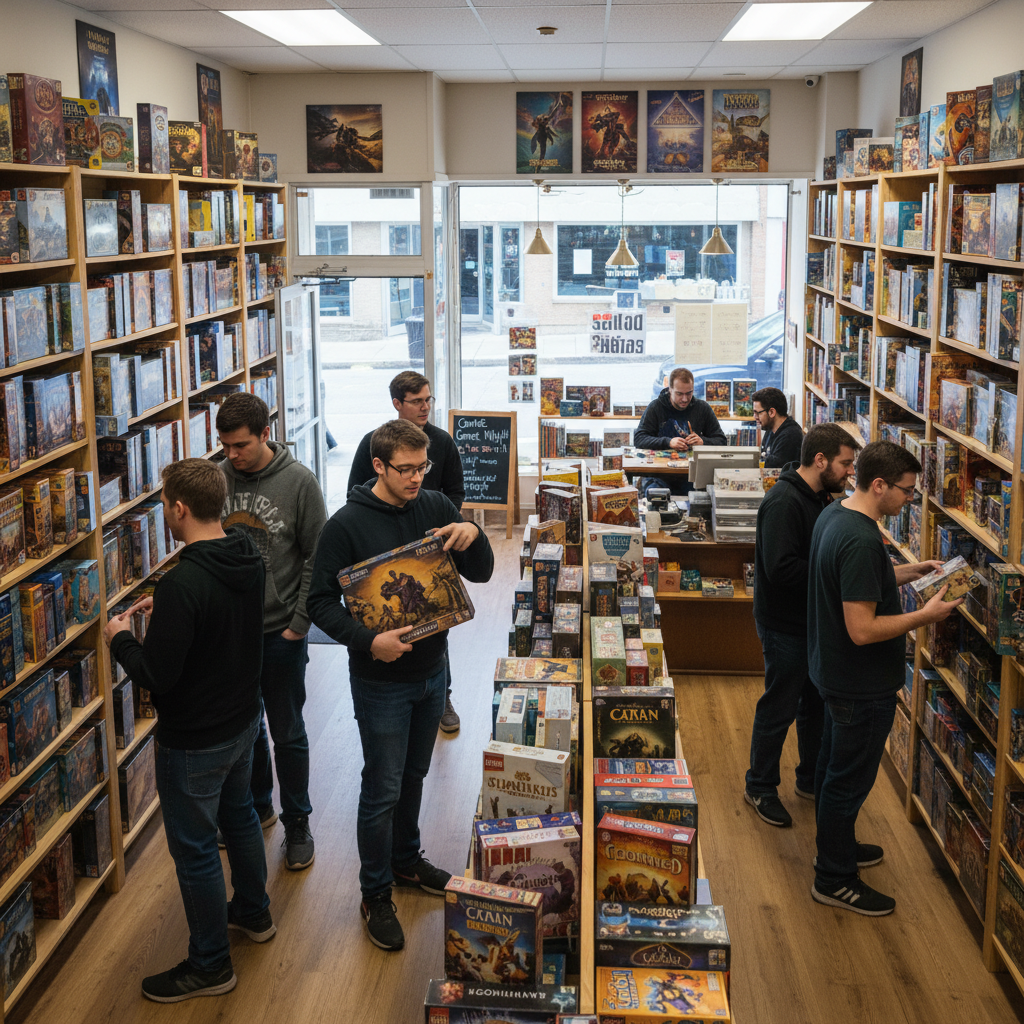
Local game stores, already struggling to compete with online retailers, may take a serious hit. Some gamers will undoubtedly reach for their “shelves of shame” and dust off unplayed games they already own, while others may try to buy online, where prices are likely to remain lower. The situation may be good for online retailers, but it’s a disaster for brick-and-mortar.
“Within a few months, US companies will lose a lot of money and/or go out of business,” Stegmaier’s post continued. “And US citizens will suffer from extreme inflation.”
Very Little Ways to Avoid Tariffs Delayed
Of course, it’s not entirely certain yet how this will shake out. And there are some potential workarounds. The tariff is only on goods produced in China. Several publishers may choose to route their shipments through non-US distributors, who are likely to be less affected (Europe, for example, is largely untariffed). That still doesn’t provide an immediate reprieve for US companies, of course; as Stegmaier notes, 65% of his company’s sales are domestic.
Beyond that, some publishers will still have some options to work with the budget cuts and avoid the tariff by delaying releases until 2020. That’s cold comfort to those with products already in production, and the shipping container en route from China. As Chris Solis, head of California-based Solis Game Studio, put it, “I have 8,000 games leaving a factory in China this week and now need to scramble to cover the import bill.”
GAMA Is Lobbying, but Changes Aren’t Coming
The Game Manufacturers Association (GAMA), the trade group for board game publishers, has been making a pitch to the Trump Administration over the tariff. However, at this time, those efforts have borne little to no fruit.
The board game industry is one of those modern success stories. Built on top of creativity, joy, and the shared social experience of playing a game, it’s not an industry that makes anyone rich. But it’s also an industry uniquely poised to struggle with this level of upheaval. At a moment like this, those publishers and designers who can scrape by will be doing their best to help their neighbors, whether it’s by coming to the aid of their local game store or trying to make sure gamers have as many options as possible.
With the best in the business bracing for upheaval, how the board game industry will change over the next year remains to be seen.